QingdaoShop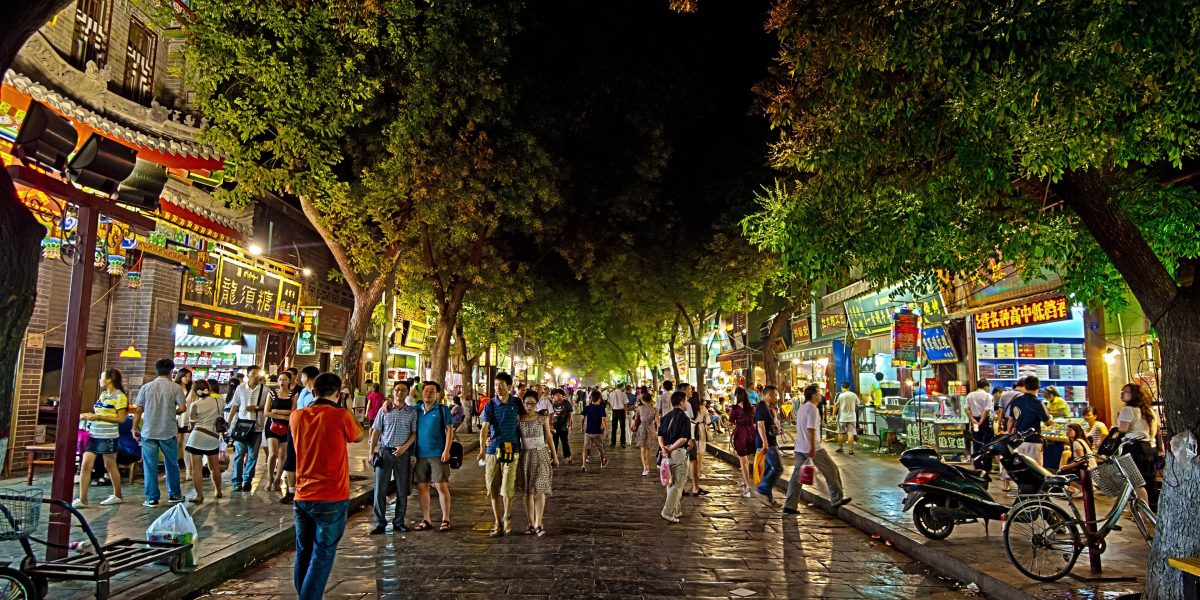
Xi’an’s Muslim Quarter is one of those places that makes you question what you think you’re traveling for. On paper, it’s perfect: dense streets, loud flavors, history you can taste, a neighborhood that can carry an entire evening. In practice, it can feel like a test of patience—less “wander and discover,” more “shuffle forward, hold your phone high, don’t lose your friend.”
The thing is, both impressions are true, and the Quarter doesn’t really hide the contradiction. It’s a living neighborhood that also functions as a tourist product. It’s a place where the smell of cumin can pull you in like a magnet, and a place where the loudest signs are sometimes trying a little too hard to do your thinking for you.
If you’ve ever left a famous food street feeling oddly unsatisfied—full, but not happy—you already know the problem isn’t that the food was “bad.” The problem is that the environment trains you to consume quickly. You stop noticing texture, pacing, and choice. You start buying what’s easiest to buy. The Quarter rewards the opposite approach.
What most visitors experience first is the main lane: bright lights, aggressive menus, and a crowd that moves like a slow conveyor belt. It’s stimulating in the way a theme park is stimulating. You can absolutely have a good time there, especially if it’s your first night in Xi’an and everything feels new. But you can also feel your attention getting pulled outward—toward the noise, the lines, the flashiest stalls—rather than inward, toward your own appetite and rhythm.
That’s why the most useful “tip” here isn’t a specific stall name. It’s a behavioral shift: stop treating the Quarter as a single destination you’re supposed to complete, and start treating it as a neighborhood you’re allowed to read. If the main lane feels like a crowd simulation, step one street over. If the line isn’t moving, don’t romanticize it as a sign of quality; assume it’s a sign of friction. If a stall looks like it was designed for photos before it was designed for taste, keep walking without guilt. The Quarter is a place where walking away is part of eating well.
There’s also a pacing issue that gets overlooked. Many people arrive hungry in the wrong way—starving, as if the first bite should solve the whole night. That’s how you end up with a giant sandwich immediately, then a slow decline into “I guess we should try one more thing,” even though you’ve stopped tasting anything. A better evening here looks more like a sequence than a conquest: something sharp early, something warm and aromatic, a reset, and then one slow finish. You don’t need thirty bites. You need a good arc.
The Quarter’s best foods tend to share a few quiet qualities. They’re hot and they move fast. They’re prepared in a way that makes sense when you watch for ten seconds. The shop is busy enough that nothing sits around and waits for you. In places like this, turnover is a form of hospitality. It keeps flavors alive, it keeps the kitchen honest, and it usually keeps your stomach safer than any online rating.
That’s the part that feels most “Xi’an” to me—not one iconic dish, but the logic of the street. Cumin and chili are not just flavoring; they’re a language. Bread isn’t just a side; it’s a tool for making a meal portable. Cold noodles aren’t a random snack; they’re how you keep your palate awake when the night threatens to become one long note of smoke and spice. When you start seeing the Quarter as a set of responses to crowd, climate, and habit, it becomes more interesting than a food court with history.
Of course, the Quarter is also performing, and you don’t need to feel superior about that. Tourist energy is part of modern city life. The problem is when performance becomes the only thing you’re interacting with. If you’re the kind of traveler who likes to feel a city’s texture—how it breathes, how it shifts between loud and quiet—the Quarter gives you that texture as soon as you stop insisting on the “most famous” version of it.
Here’s what I’d do if I wanted the Quarter to feel like a place rather than a task. I’d go a little earlier than the peak crush, not because I’m afraid of crowds, but because the neighborhood’s rhythm is easier to read before it turns into pure density. I’d start with something bright and cold, because that sets the tone and keeps me from overeating early. I’d buy skewers only when the grill is clearly alive—real heat, steady flipping, food going directly from fire to hand. I’d keep drinks small. Then I’d finish with one sit-down bowl, the kind of meal that forces you to slow down and stop browsing. After that, I’d walk out through quieter lanes and let the night settle. The best end to a food crawl is not another purchase; it’s a few minutes where you realize you’re satisfied.
None of this is meant to take the romance out of street food. If anything, it brings the romance back. The Quarter can be wonderful when you approach it with a little agency—when you act like you’re allowed to choose the pace, the lane, the moment you stop, the moment you move on. Cities like Xi’an don’t need you to eat more; they need you to notice more.
And if you leave thinking, “I should come back and do it differently next time,” that’s not a failure. That’s the Quarter working as intended. It’s not a single evening’s checklist. It’s a neighborhood you learn in layers, the way you learn any place that’s both famous and real.