Best Meat Thermometers (2026): Instant-Read, Wireless & Budget Picks Tested
Photo: Pexels (free license)
Quick Comparison: Our Top Picks
| Model | Type | Read Speed | Rating |
|---|---|---|---|
| 🥇 ThermoWorks Thermapen One | Instant-read | <1 second | ★★★★★ |
| 🥈 Lavatools Javelin PRO Duo | Instant-read | 2–3 seconds | ★★★★★ |
| 🥉 MEATER Plus | Wireless leave-in | Continuous | ★★★★★ |
| ThermoWorks ChefAlarm | Leave-in with alarm | Continuous | ★★★★★ |
| Kizen Instant Read | Instant-read | 2–4 seconds | ★★★★★ |
Table of Contents
How We Tested
We measured each thermometer against four standards over six weeks of real cooking:
- ▸ Speed: How quickly does it give a stable reading? We tested in ice water (32°F) and boiling water (212°F).
- ▸ Accuracy: We cross-referenced readings against a NIST-calibrated reference thermometer.
- ▸ Ease of use: Can you operate it with one hand while cooking? Is the display readable in sunlight?
- ▸ Durability: Water resistance, drop resistance, and battery life.
ThermoWorks Thermapen One
The Thermapen One reads in under 1 second. Not 2–3 seconds like most "instant-read" thermometers — literally less than 1 second. That speed matters when you're lifting a grill lid, checking a steak at temperature, and trying not to lose heat. The ±0.5°F accuracy is the industry benchmark, and ThermoWorks has the ISO/IEC 17025 accredited calibration lab to prove it.
The rotating display automatically flips based on how you hold it. The backlit screen is readable in bright sunlight and pitch darkness. The probe tip is among the smallest on the market (1.5mm), so it minimizes meat puncture. At $105, it's not cheap — but serious cooks who buy it never regret it. Rated IP67 waterproof, so it survives full submersion and dishwasher splashes.
Key Specs
- Read speed: <1 second
- Accuracy: ±0.5°F (±0.3°C)
- Range: -58°F to 572°F
- Water resistance: IP67
- Battery: AAA (3,000 hrs)
Pros
- Fastest instant-read available (<1 second)
- ±0.5°F industry-leading accuracy
- Auto-rotating display
- IP67 waterproof rating
- Ultra-thin 1.5mm probe tip
Cons
- Expensive ($105)
- Instant-read only — not a leave-in thermometer
Lavatools Javelin PRO Duo

At around $50, the Lavatools Javelin PRO Duo is the closest thing to Thermapen performance at half the price. It reads in 2–3 seconds with ±0.9°F accuracy — not quite Thermapen-level, but more than adequate for 95% of cooking applications. It includes a magnetic back, ambidextrous display, and a hold function.
The PRO Duo version adds a secondary ambient temperature sensor and improved splash resistance (IP65 rated). Build quality is excellent for the price, and it comes with a built-in magnet that attaches to your fridge or oven. A fantastic choice for home cooks who want a significant upgrade from cheap dial thermometers without the Thermapen price tag.
Key Specs
- Read speed: 2–3 seconds
- Accuracy: ±0.9°F
- Range: -40°F to 482°F
- Water resistance: IP65 splash-proof
- Extras: Magnetic back, hold function
Pros
- Excellent value — near-Thermapen performance at half cost
- Ambidextrous design
- Built-in magnet for storage
- IP65 splash-resistant
Cons
- 2–3 seconds vs. Thermapen's sub-1-second
- Accuracy ±0.9°F (less precise than Thermapen)
MEATER Plus Wireless Smart Meat Thermometer

The MEATER Plus is the most popular wireless meat thermometer for good reason: it's completely wireless (no cables through grill vents), connects to your phone via Bluetooth up to 165 feet away, and provides guided cooking with automatic rest time calculations. Leave the probe in a roast while it slow-cooks in the oven and monitor from the couch.
It measures both internal meat temperature and ambient (oven/grill) temperature simultaneously using two sensors in one probe. The bamboo charger doubles as a Bluetooth repeater. App integration is excellent — it tells you when to pull the meat based on your target temperature and accounts for carryover cooking. Best for low-and-slow BBQ, roasts, and smoking.
Key Specs
- Type: Wireless leave-in
- Bluetooth range: 165 feet (MEATER+)
- Sensors: Internal + ambient
- App: iOS & Android
- Max internal temp: 212°F
Pros
- 100% wireless — no cables
- 165 ft Bluetooth range
- Guided cooking with rest time alerts
- Measures ambient + internal temp
Cons
- Requires smartphone — not great for oven-only cooks
- Internal max 212°F — can't be used at very high sear temps
- Higher price (~$99)
ThermoWorks ChefAlarm
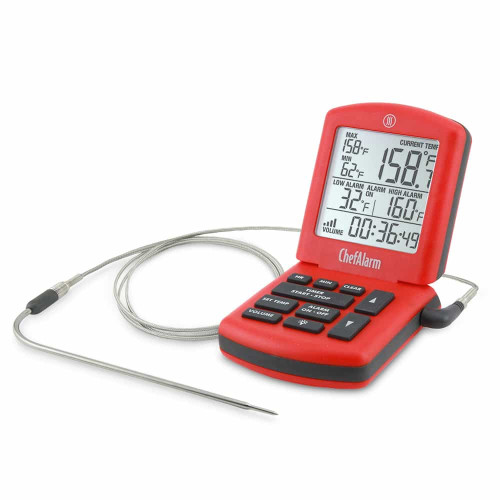
For oven roasting and candy making — tasks where you leave the probe in and want an alert when the target temp is hit — the ChefAlarm is the professional standard. At around $59, it's far more affordable than MEATER and doesn't require a smartphone. The loud alarm is audible from across the kitchen (or outside if grilling).
The silicone-sleeved probe cable withstands up to 700°F ambient temperature, making it suitable even for high-heat oven applications. It has both high- and low-temperature alarms, so you can set a range for precision candy and chocolate work. Simple, reliable, and battle-tested in professional kitchens for years.
Key Specs
- Type: Leave-in with alarm
- Accuracy: ±1.8°F
- Range: -58°F to 572°F
- Cable max temp: 700°F
- Alarms: High + low
Pros
- No smartphone required
- High + low temperature alarms
- Cable survives 700°F — works in high-heat ovens
- Used by professional chefs and pitmasters
Cons
- Requires wired connection to probe
- No wireless monitoring from another room
Meat Thermometer Buying Guide
1. Instant-Read vs. Leave-In
Instant-read thermometers (Thermapen, Javelin PRO) are for quick spot-checks — you insert, read, remove. They're essential for searing steaks or checking chicken doneness. Leave-in thermometers (MEATER, ChefAlarm) stay in the meat while it cooks, giving continuous monitoring and alarms. Ideally, serious cooks have both.
2. Accuracy Matters More Than You Think
The difference between 145°F (safe pork) and 160°F (overcooked) is just 15 degrees. A thermometer with ±3°F accuracy can mean the difference between perfect and dry. Spend for accuracy — it pays off every single cook.
3. Safe Internal Temperatures (USDA)
- Beef/Pork/Lamb (steaks, roasts): 145°F + 3-min rest
- Ground beef/pork: 160°F
- Poultry (all): 165°F
- Fish: 145°F
- Ham (pre-cooked, reheated): 140°F
4. Water Resistance
Look for IP65 (splash-proof) at minimum. IP67 (submersion-proof, like the Thermapen One) is ideal. Thermometers get wet — from marinades, basting, and cleaning. A non-waterproof unit will fail quickly in a working kitchen.
Frequently Asked Questions
Is the Thermapen One worth $105?
Yes, if you cook meat regularly. The sub-1-second read speed means you can check multiple spots in a large roast in seconds, losing minimal heat. The accuracy means you'll never serve undercooked chicken or dry, overcooked steak again. Divided over 10+ years of use, it costs pennies per meal.
Can I use a meat thermometer for candy making?
Yes, as long as the range goes high enough. Sugar reaches 350°F+ for caramel. Most meat thermometers max at 572°F, which covers all candy stages. The ThermoWorks ChefAlarm with its high+low alarms is particularly well-suited for candy and chocolate tempering.
Where should I insert a meat thermometer?
Always insert into the thickest part of the meat, avoiding bone (bone conducts heat differently than muscle). For whole poultry, check the thigh at the thickest point. For steaks, insert from the side horizontally to reach the center. Check multiple spots in large cuts.
Our Final Recommendation
For most cooks, start with the Lavatools Javelin PRO Duo — it's the best thermometer under $50 we've found. If you're serious about cooking (especially steaks and BBQ), upgrade to the ThermoWorks Thermapen One — you won't look back. For smoking and slow roasting, add a MEATER Plus for hands-free monitoring.