QingdaoShop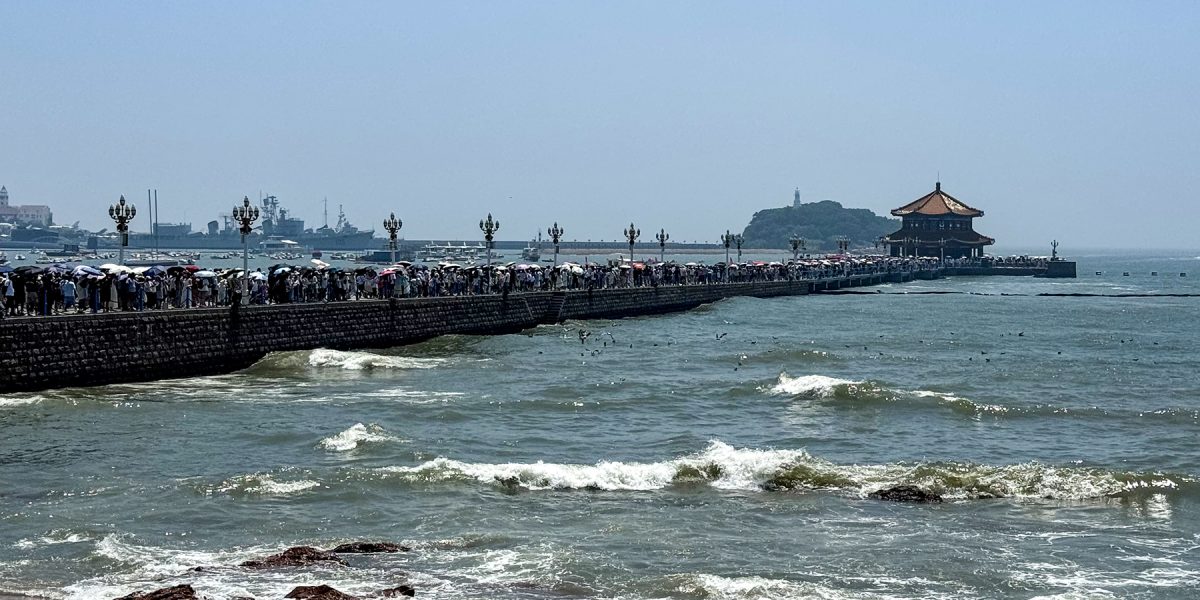
In Qingdao, the sea is never just scenery. It behaves like a second clock: you feel it in the way the promenade fills and empties, in how the air turns salty a few streets inland, in the quick changes of light that make the same block look newly painted and then suddenly tired. On some mornings the water sits flat as glass and the city seems oddly precise, like it’s holding its breath. On others, the wind roughens the surface and the whole place becomes a little louder, even before anyone speaks.
That moodiness is part of the bargain you make with a coastal city, but Qingdao adds an extra twist: it refuses to be one thing at a time. It’s a beer city and a bathhouse city, a postcard shoreline and a working port, a place where wedding photos compete with cargo logistics and nobody finds the combination strange. Visitors often arrive expecting a neat “seaside escape,” something restful and decorative; locals tend to treat the coast as a daily corridor, like an elongated town square that just happens to have waves. Somewhere between those two expectations, you start to realize that Qingdao’s real character isn’t in its landmarks, but in the way it edits your pace.
Stand near Zhanqiao early enough and you can watch that editing happen in real time. The pier looks like a sentence you’ve heard before—wood, railing, a pavilion at the end—until the city begins to annotate it: retirees pacing with hands behind their backs, delivery scooters threading through gaps that don’t look wide enough, someone testing the temperature of the air with a slow inhale. The sea doesn’t invite you to “do” anything specific; it asks you to linger, which is harder for most modern cities than it sounds. In Qingdao, lingering is not a luxury activity. It’s a default setting that the shoreline keeps turning back on.
The Promenade as a Social Border
Every city has borders you can’t see, and in Qingdao the clearest one is drawn by the sound of water. On the inland side, you have the practical city—bus stops, schools, morning markets, the ordinary friction of getting somewhere on time. On the seaward side, the pace loosens, and people who were walking as if chased suddenly drift as if they’ve remembered they have bodies. The same person can cross that line twice a day and become, for a while, a different version of themselves.
It’s tempting to call the promenade a “public space,” but that phrase can be too polite for what’s actually going on. Public space is where a city negotiates who gets to be visible, and Qingdao’s coastline is a stage where visibility is both easy and a little awkward. Many visitors notice how quickly they’re pulled into the choreography—slowing down, turning their phones outward, looking for the angle that proves they were here. At the same time, there’s a parallel choreography that doesn’t care about being photographed: stretching routines timed to the tide, quiet conversations that hover between dialect and Mandarin, the habitual scanning of the horizon the way inland people scan a streetlight. The shoreline holds both kinds of attention without reconciling them.
This is where Qingdao’s tourist-versus-life tension becomes more interesting than the usual complaint about crowds. The issue isn’t simply that tourists take up space. It’s that tourists arrive with a different definition of the moment. A visitor wants the moment to be complete—framed, captured, narrated—while a local wants the moment to continue, to be repeatable tomorrow with small variations. When those definitions collide, you feel it as impatience in a queue, as a shoulder angled a little too sharply, as a polite smile that is really a request for you to move along. The sea watches this with the neutrality of something that has outlasted everyone.
And yet, the coastline is one of the rare places where the city’s hierarchy briefly flattens. A teenager with a skateboard, a grandmother with a plastic stool, a man in an office shirt rolled up at the wrists—they all stand at the same railing and stare at the same gray-blue distance. The view doesn’t reward status; it rewards presence. If you stay long enough, the whole performance of “having a day” relaxes into something simpler: breathing, watching, letting your mind idle. Qingdao’s shoreline, at its best, is not entertainment. It’s a permission slip.
That permission is seasonal, and the seasons here are not subtle. In summer the coast is an extrovert: bright umbrellas, loud sandals, the damp sweetness of fruit cups and sunscreen. In winter it becomes a quieter, more private city, even when it’s crowded, because the cold narrows everyone’s gestures. Scarves pull faces inward; hands disappear into pockets; speech shortens. The light changes too—lower, whiter, as if the air has been rinsed—and suddenly the German-era facades and red roofs look less like heritage and more like ordinary housing that happened to survive a century of remodeling. In that colder light, Qingdao feels like it’s telling the truth about itself.
Truth, in a city, is often a matter of distance. From the sea you can see the skyline of the newer districts, the clean vertical confidence that could belong to any prosperous coastal metropolis. Then you turn around and walk uphill, and the city becomes more idiosyncratic: older lanes that kink unexpectedly, little stairways that imply you’re supposed to take your time, small parks that are less “destination” than pause button. The contrast isn’t just architectural; it’s emotional. The newer city suggests efficiency and future, while the older slopes suggest memory and repetition. Qingdao keeps them close enough that you can experience both in a single afternoon, which makes the contrast harder to ignore and easier to think about.
One reason the contrast feels so sharp is that the sea doesn’t let the city hide behind its own noise. Inland, a city can cover its contradictions with traffic and neon and the busy logic of commerce. Along the water, everything is exposed: the awkward angles of new development, the sudden emptiness of winter beaches, the tired paint on a railing that has been touched by thousands of hands. Even the famous beer identity—so often reduced to branding—feels different near the shore. It becomes less about festival energy and more about the ordinary pleasure of salt air followed by something cold and bitter, the kind of small reward that doesn’t need a slogan.
Qingdao’s cafés, too, make more sense when you see them as part of this pacing system rather than as a trend imported from elsewhere. A café near the coast is not merely a place to consume; it’s a buffer zone between exposure and comfort. You come in with the wind still on your jacket, order something warm or iced depending on the season’s mood swings, and watch the glass fog and clear as people pass outside. The best ones don’t try too hard to be “coastal aesthetic.” They simply provide a window, a chair, and time that feels usable. In a city where the sea keeps rewriting your schedule, cafés become the punctuation marks that make the sentence readable.
At night, the shoreline can look theatrical, and it’s easy to mistake the lighting for glamour. But the more interesting detail is how people use darkness to soften the day’s boundaries. Couples take slower walks; groups gather in looser circles; the conversations lengthen because there’s less to point at and more to listen to. You can sense the city’s daily negotiation shifting from “What are we doing?” to “Where are we?”—a quieter question, but a deeper one. The sea, which in daylight feels like a view, becomes a presence you can’t quite see, and that invisibility makes it more powerful.
What all of this adds up to is a city that teaches you a particular kind of attention. Qingdao doesn’t demand that you chase novelty, even though it has plenty of it, and it doesn’t reward the checklist mentality that people bring to famous places. Instead, it rewards the ability to notice small differences: the way the wind changes when you step from a sheltered street to an open corner, the way the smell of kelp appears and vanishes, the way people’s shoulders drop when they reach the railing. These are not “activities,” and they don’t translate well into recommendations. They are the texture of a place that expects you to return, even if you don’t.
That expectation—return—is the quiet argument Qingdao makes. It doesn’t try to be a once-in-a-lifetime city, and that’s part of its strength. It’s a city that grows on you through repetition: the same route along the water at different hours, the same hill climbed in different weather, the same view that refuses to look identical twice. If you leave with anything, it’s less a memory of a landmark than a memory of how your pace changed when the sea was beside you.
In the end, Qingdao’s coastline isn’t a backdrop; it’s a social instrument. It sets tempo, exposes contradictions, and offers small, daily dissolutions of urgency that people learn to depend on. You can come here looking for a picture-perfect shore, and you’ll find one, but the more lasting impression is subtler: a city that keeps reminding you that time is not only measured by calendars and clocks. Sometimes it’s measured by wind, by light, and by how long you’re willing to stand still without needing a reason.